Upgrading an exhaust system is one of the most popular modifications for drivers who want a deeper exhaust note, a more aggressive appearance, and potentially improved exhaust flow.
But once you start shopping for an aftermarket exhaust, one question appears again and again:
Cat-back vs. axle-back exhaust — which one is better?
Both systems can change the way a vehicle sounds and looks, but they replace different sections of the factory exhaust and are designed for different priorities.
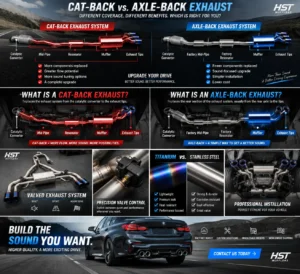
An axle-back exhaust usually focuses on the rear section of the vehicle, replacing the mufflers, rear piping, and exhaust tips.
A cat-back exhaust system replaces a larger portion of the exhaust path, generally starting behind the catalytic converter and continuing to the exhaust tips.
That difference affects cost, installation, sound, exhaust flow, weight, and overall upgrade potential.
This guide explains the difference between cat-back and axle-back exhaust systems, how each affects sound and performance, and which type may be better for your vehicle.
What Is a Cat-Back Exhaust System?
A cat-back exhaust system replaces the exhaust components located after the catalytic converter.
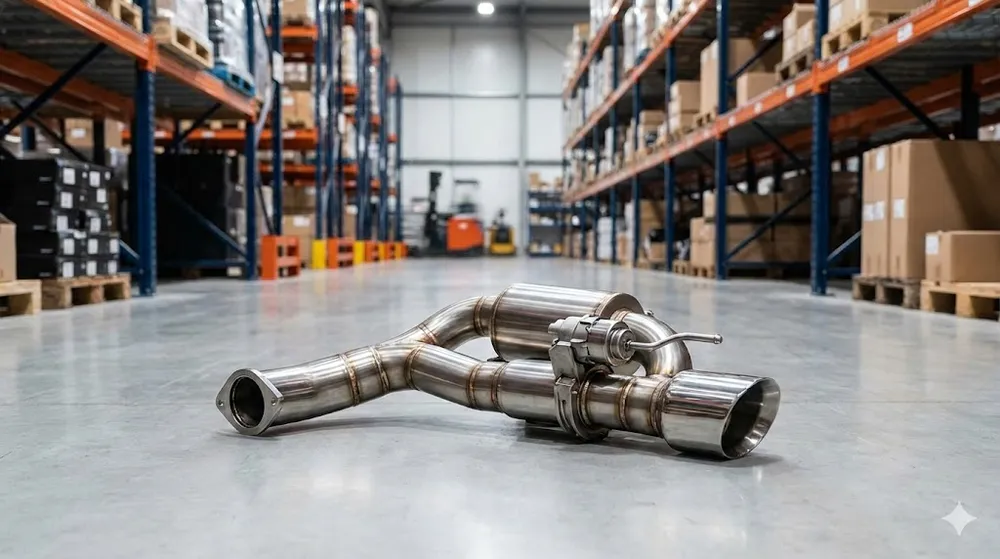
Depending on the vehicle, a typical cat-back system may include:
- Mid-pipe
- Resonator
- X-pipe or H-pipe
- Muffler
- Tailpipes
- Exhaust tips
- Clamps and hangers
The exact configuration depends on the vehicle platform.
Some vehicles have a simple single-pipe layout, while others use dual exhaust tubing, crossovers, resonators, or multiple mufflers.
Because a cat-back replaces more of the factory exhaust path, it gives manufacturers more opportunities to modify exhaust flow, tubing diameter, resonator design, muffler design, and exhaust sound.
Current Borla and MagnaFlow product definitions both describe cat-back systems as replacing the exhaust path behind the catalytic converter toward the rear of the vehicle.(Source:Borla)
Why Do Drivers Choose a Cat-Back Exhaust?
A cat-back exhaust is often selected when the driver wants a more complete upgrade.
Common reasons include:
- Deeper or more aggressive exhaust sound
- Improved exhaust flow
- Larger or optimized exhaust tubing
- Mandrel-bent piping
- High-flow mufflers
- Reduced system weight in some applications
- Improved rear appearance
- Better compatibility with future performance modifications
For enthusiasts looking for both sound and performance potential, the cat-back is usually the more comprehensive option.
What Is an Axle-Back Exhaust?
An axle-back exhaust system replaces the exhaust components behind or around the rear axle.
It commonly includes:
- Rear muffler or mufflers
- Short sections of rear exhaust tubing
- Tailpipes
- Exhaust tips
- Clamps and hardware
Most of the factory mid-pipe and resonator system remains in place.
Because less of the original exhaust is replaced, an axle-back upgrade generally focuses more on sound and appearance than on changing the complete exhaust flow path.
Borla describes axle-back systems as covering the rear mufflers, piping, and tips, while MagnaFlow similarly positions them as a simpler sound-focused upgrade.(Source:Borla)
Why Do Drivers Choose an Axle-Back Exhaust?
An axle-back system can be a strong choice when the main priorities are:
- Louder or deeper exhaust sound
- Better-looking exhaust tips
- Lower cost
- Simpler installation
- Retaining most of the factory exhaust system
- Avoiding a more extensive exhaust modification
For many daily drivers, an axle-back can deliver the change they want without replacing a large portion of the original exhaust.
Cat-Back vs. Axle-Back Exhaust: Main Differences
The easiest way to understand the two systems is to compare how much of the factory exhaust they replace.
| Feature | Cat-Back Exhaust | Axle-Back Exhaust |
| Section replaced | Catalytic converter area to rear | Rear axle area to tips |
| Mid-pipe replaced | Usually | No |
| Resonator changes | Possible | Usually retained |
| Muffler replaced | Usually | Usually |
| Exhaust tips | Usually included | Usually included |
| Sound change | Moderate to major | Mild to major |
| Flow potential | Higher | More limited |
| Installation | More involved | Usually simpler |
| Typical price | Higher | Lower |
| Best for | Sound + flow + broader upgrade | Sound + appearance |
This is a general comparison.
Vehicle-specific exhaust layouts vary, so always check exactly which components are included before buying.
Cat-Back vs. Axle-Back Sound: Which Is Louder?
For many buyers, sound is the most important factor.
But there is no rule saying:
Cat-back is always louder.
or
Axle-back is always quieter.
Exhaust sound depends on several variables:
- Muffler design
- Resonator design
- Number of mufflers
- Pipe diameter
- Engine displacement
- Turbocharged vs. naturally aspirated engine
- Number of cylinders
- Exhaust tip design
- Factory exhaust valves
- Crossover design
- Vehicle cabin insulation
A very aggressive axle-back with small, free-flowing mufflers can be louder than a conservative cat-back designed for comfortable street use.
However, a cat-back gives the exhaust manufacturer control over more of the exhaust path.
That means there is greater opportunity to shape both volume and tone.
Borla currently positions its cat-back systems as offering broader exhaust-path tuning, while axle-back systems target a more accessible sound upgrade from the rear section.(Source:Borla)
Exhaust Tone vs. Exhaust Volume
These two terms are often confused.
Volume means how loud the exhaust is.
Tone describes the character of the sound.
A performance exhaust may sound:
- Deep
- Aggressive
- Refined
- Raspy
- Smooth
- High-pitched
- Low-frequency
- Metallic
A quality exhaust upgrade should not be judged only by maximum loudness.
For many drivers, a deeper and cleaner tone is more important than simply making the vehicle louder.
This is especially true for daily-driven cars.
What About Exhaust Drone?
One of the most important issues in any exhaust upgrade is drone.
Exhaust drone is a low-frequency resonance that can become noticeable inside the vehicle at certain engine speeds.
It often appears during highway cruising.
A system may sound excellent during hard acceleration but become uncomfortable at a constant RPM.
Factors that influence drone include:
- Muffler design
- Resonator placement
- Pipe length
- Pipe diameter
- Engine RPM
- Vehicle cabin characteristics
- Number of exhaust paths
- Crossover configuration
If your vehicle is a daily driver, cruising comfort should be part of the decision.
A properly designed cat-back system may use resonators and muffler tuning to control unwanted frequencies.
An axle-back may retain the factory resonator system, which can sometimes help preserve everyday comfort.
Which Is Better for Performance?
If your main goal is exhaust flow and performance potential, a cat-back exhaust generally offers more opportunity for improvement.
The reason is straightforward:
It replaces more of the exhaust system.
An axle-back leaves most of the factory tubing untouched.
Even if the rear muffler is less restrictive, any restrictions in the mid-pipe, resonators, or other sections remain.
A cat-back system can modify:
- Exhaust pipe diameter
- Mandrel bends
- Mid-pipe geometry
- Resonator design
- Crossover design
- Muffler flow characteristics
MagnaFlow notes that cat-back systems are commonly designed to improve exhaust flow through upgraded tubing and mufflers, while axle-back systems are more strongly focused on sound.(Source:MagnaFiow)
Does a Cat-Back Exhaust Add Horsepower?
It can, but the amount varies significantly by vehicle.
There is no universal horsepower number.
Potential gains depend on:
- Factory exhaust restriction
- Engine displacement
- Turbocharged or naturally aspirated configuration
- Pipe diameter
- Muffler design
- Other engine modifications
- ECU tuning
- Intake system
- Headers or downpipes
- Existing exhaust layout
If the factory exhaust is already efficient, replacing it may produce only a modest performance difference.
On a modified vehicle with higher airflow requirements, a properly sized cat-back may become more valuable.
This is why exhaust upgrades should be considered as part of the complete engine setup.
Does an Axle-Back Exhaust Add Horsepower?
An axle-back may reduce restriction at the rear of the system if the factory muffler is restrictive.
However, because most of the original exhaust remains in place, its potential impact on total exhaust flow is usually smaller.
For most buyers, an axle-back should primarily be viewed as:
Sound + Appearance
rather than:
Major Performance Modification
That does not make it a poor upgrade.
It simply means the purpose is different.
Cat-Back vs. Axle-Back for Daily Driving
A daily driver needs more than an aggressive cold-start sound.
You should also consider:
- Highway cruising
- Cabin noise
- Passenger comfort
- Neighborhood noise
- Local regulations
- Long-distance driving
An axle-back can be attractive because it changes the sound while retaining more factory components.
A well-engineered cat-back can also work very well for daily use, especially if the system includes resonators or valve control.
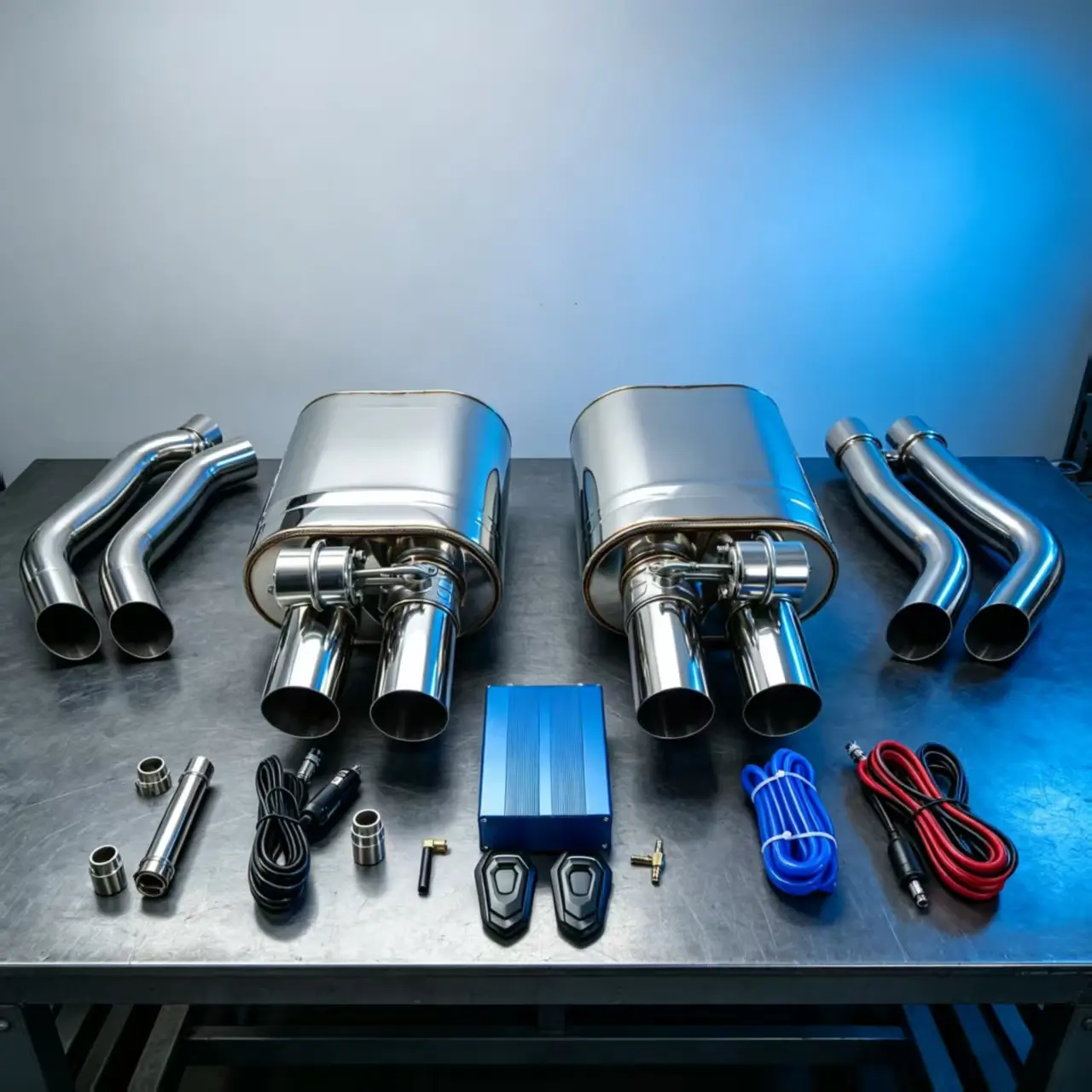
Modern valved exhaust systems can provide another option.
With a valved exhaust, the driver can change the exhaust path or sound level depending on driving conditions.
This can help create a balance between quieter cruising and a more aggressive sound when desired.
Cat-Back vs. Axle-Back Cost
An axle-back usually costs less because fewer components are included.
A cat-back requires more:
- Tubing
- Bends
- Welding
- Resonators
- Hangers
- Hardware
- Muffler engineering
The exact price difference varies by vehicle and material.
A stainless steel axle-back may be much more affordable than a full titanium cat-back.
But cost should be viewed together with long-term goals.
If you eventually plan to replace the entire exhaust, buying an axle-back first and replacing it later may not be the most economical path.
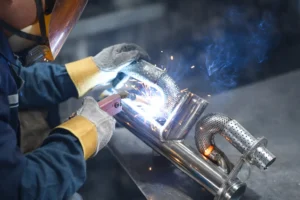
Stainless Steel vs. Titanium Exhaust
Material choice is another major factor.
Stainless Steel Exhaust
A stainless steel exhaust system is popular because it balances strength, durability, corrosion resistance, and cost.
For aftermarket performance applications, stainless steel is commonly chosen for:
- Long service life
- Strong construction
- Corrosion resistance
- Good value
- Polished appearance
T304 stainless steel is widely used in premium aftermarket exhaust systems. Borla, for example, currently emphasizes T-304 stainless construction across its cat-back and axle-back lines.(Source:Borla)
Titanium Exhaust
Titanium is often selected for higher-end performance applications.
Its main advantages include:
- Lower weight
- Strong heat resistance
- Corrosion resistance
- Premium appearance
- Distinctive sound characteristics in some systems
However, titanium generally costs more.
For a street-driven car focused on durability and value, stainless steel may be the better choice.
For a performance build focused on weight reduction and premium construction, titanium may be more attractive.
What About Valved Exhaust Systems?
A valved exhaust system adds another layer to the cat-back vs. axle-back decision.
An exhaust valve changes how gases move through the muffler or bypass section.
Depending on the design, this can allow the driver to choose between:
Valve Closed
- More controlled sound
- Better cruising comfort
- Reduced exterior volume
Valve Open
- More aggressive exhaust note
- More direct exhaust path
- Stronger performance character
Valved systems are especially popular on performance cars because they allow one vehicle to have two different personalities.
For drivers who use the same vehicle for daily commuting and spirited driving, a valved cat-back can provide a strong balance.
Which Is Easier to Install?
Axle-back systems are generally easier because fewer components are replaced.
Some systems are direct bolt-on.
Others may require cutting and clamping.
Borla notes that installation method varies by vehicle: both cat-back and axle-back systems can be bolt-on or cut-and-clamp depending on the application.Borla
A cat-back installation may require additional time because the installer must align:
- Mid-pipe
- Resonator
- Muffler
- Tailpipes
- Exhaust tips
- Hangers
Correct alignment matters.
Poor installation can cause:
- Exhaust leaks
- Rattles
- Uneven exhaust tips
- Chassis contact
- Vibrations
- Premature component wear
Which Exhaust Is Better for Trucks?
For pickup trucks, both options can make sense.
Choose an axle-back when your main goals are:
- Deeper sound
- Better tips
- Lower cost
- Simpler installation
Choose a cat-back when you want:
- More complete exhaust-flow improvement
- Larger tubing
- Different resonator configuration
- More aggressive system-wide sound
- Support for future engine upgrades
Truck fitment can depend on:
- Cab size
- Bed length
- Wheelbase
- Engine
- Drivetrain
Always verify fitment carefully.
Which Exhaust Is Better for Performance Cars?
For sports cars and performance vehicles, a cat-back often makes more sense when the owner plans additional modifications.
These vehicles may benefit from:
- Optimized dual exhaust routing
- X-pipes
- Larger tubing
- Valved mufflers
- Lightweight materials
- Performance-oriented resonators
An axle-back is still useful when the goal is mainly to change sound without replacing the full exhaust path.
Cat-Back vs. Axle-Back: Which One Should You Choose?
The simplest way to decide is to define your priority.
Choose an Axle-Back Exhaust If:
- Your main goal is sound
- You want lower cost
- You prefer simpler installation
- You want upgraded exhaust tips
- You want to retain most factory components
Choose a Cat-Back Exhaust If:
- You want a more complete exhaust upgrade
- You care about both sound and flow
- You plan future performance modifications
- You want more control over tubing and resonator design
- You want a system engineered as one complete package
Neither option is automatically superior.
The best exhaust system is the one that fits your vehicle and your goals.
Frequently Asked Questions
Is cat-back better than axle-back?
Not always. A cat-back replaces more of the exhaust system and offers greater potential to change sound and flow. An axle-back can be the better choice for drivers who mainly want better sound, appearance, and lower cost.
Which is louder, cat-back or axle-back?
It depends on the mufflers, resonators, engine, and pipe diameter. A cat-back gives manufacturers more control over the complete exhaust path, but an aggressive axle-back can still be very loud.
Does a cat-back exhaust increase horsepower?
It may improve exhaust flow and potentially support power gains, but results depend on the specific vehicle and engine setup.
Is an axle-back good for a daily driver?
Yes. An axle-back can be a good choice for daily drivers who want a more aggressive exhaust sound without replacing a large section of the factory exhaust.
Is stainless steel good for a performance exhaust?
Yes. Stainless steel offers strong corrosion resistance, durability, and good long-term value.
Is titanium better than stainless steel?
Titanium is lighter and often used for premium performance systems, while stainless steel generally offers better cost efficiency and excellent durability.
What is a valved exhaust system?
A valved exhaust uses electronically or mechanically controlled valves to change the exhaust path or sound level, allowing quieter cruising and a more aggressive sound when desired.
Can I upgrade from axle-back to cat-back later?
Sometimes, but compatibility depends on the system design and manufacturer. If you already know you want a complete cat-back, buying the full system first may be more efficient.
Final Verdict: Cat-Back or Axle-Back?
The cat-back vs. axle-back exhaust decision comes down to one question:
What do you want from your vehicle?
If you mainly want:
Better Sound + Better Appearance + Lower Cost
an axle-back may be the right choice.
If you want:
Better Sound + More Exhaust Flow + More Complete Performance Upgrade
a cat-back is usually the stronger option.
The most important factors are:
Vehicle + Engine + Sound Preference + Pipe Size + Muffler Design + Material + Fitment + Budget
A quality exhaust system should be designed around the vehicle rather than selected only by how loud it sounds.
If you are still deciding how pipe diameter, mufflers, materials, exhaust flow, and vehicle fitment work together, read our complete Performance Exhaust Systems Guide to understand the full exhaust setup before choosing your next upgrade.